Design Sprint - Mobility as a Service

Overview

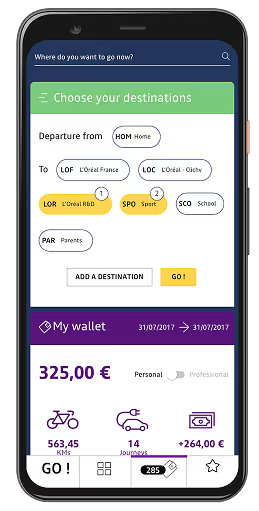
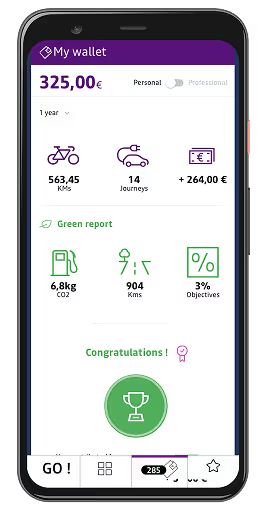
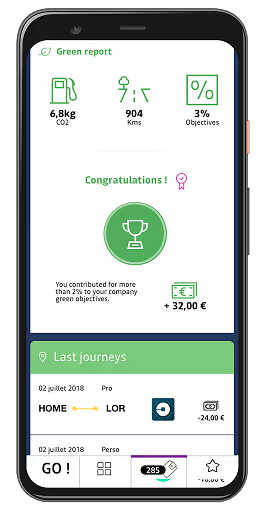
I assisted in developing the prototype of a B2B mobility service which enabled Renault Groupe to continue pushing its ‘Mobility-as-a-Service’ strategy.
After 5 days of work, the Sprint provided a concept which was able to win over stakeholders and started the full scale internal project to be completed by dedicated resources. 

Context

Event: Paris Design Jam.
Organizer: TTC Labs
Topic: Privacy by Design & Data Protection
Format: Joint workshop based on design jam methodology

Role

Senior product designer, player-coach within cross-functional team

Timeline

2018 - 5 day Sprint and additional work following

Context & Problem

Renault understood they could not depend on the traditional car ownership models in a market that was increasingly shifting toward shared mobility. New competitors were saturating the ‘Mobility-as-a-Service’ sector.

Renault needed to find new ways of winning in an increasingly competitive market. 

Challenge

Rest of the Renault business developed Renault’s mobility vision: ecosystem of usage expanding beyond just vehicles,
the core of rest of the Renault business.Many possible solutions were redundant; the real challenge was rapidly determining
one of real value and demonstrating value in a small period of time to the sponsors.
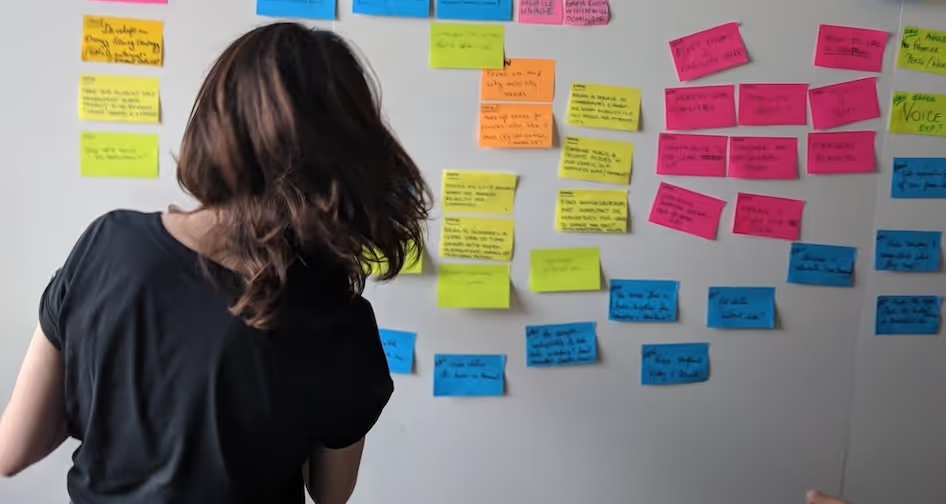
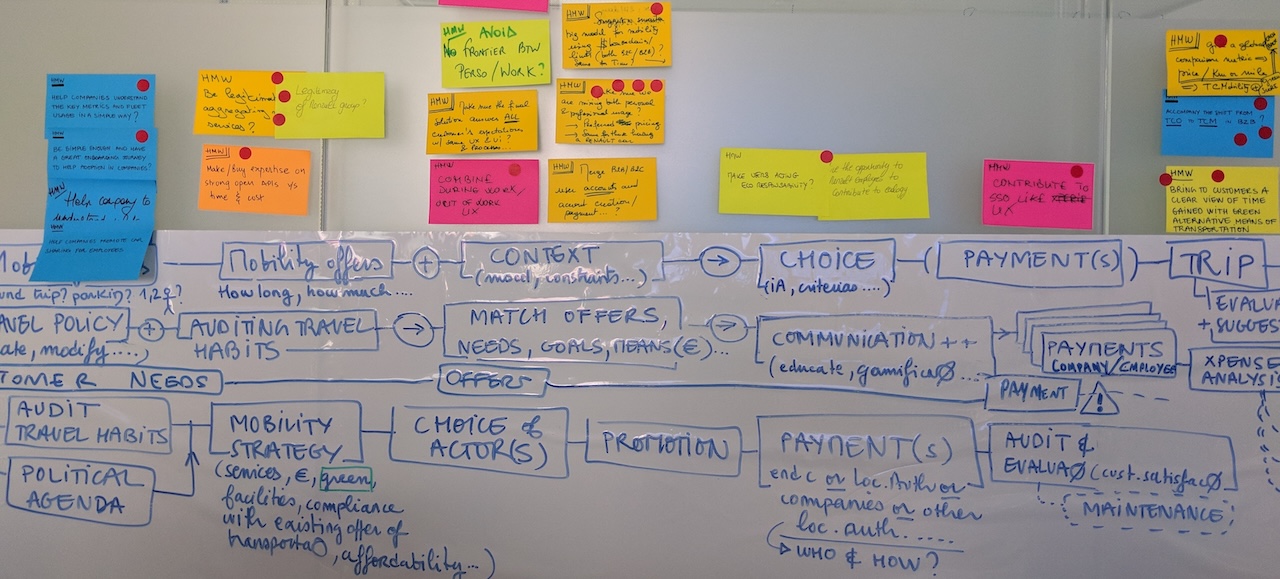
Yellow post-it notes on a whiteboard
Notes

Scope 

I was tasked with combining elements of strategy and design.

I assisted in hoping setting long term goals and capturing conversations to keep conversations heading towards the desired outcome.
I managed the User Experience and User Interface Design when it was the time to transform ‘talk’ into ‘touchable output.’

On the fourth day, I was able to deliver a prototype that was functional, and could be tested and demonstrated.I didn’t just design screens though.
I directed the team towards a B2B fleet service when the group started focusing too much on consumer ideas.
That change held the sprint in a concept that had actual commercial value. 

Process & Approach

Discovery & Research

We started by mapping the mobility landscape and pulling in expert knowledge, then testing assumptions with competing companies.

Mapping the mobility landscape

Early Integration

To boost conversion rates with better user journey

Strategy

I defined core flows that captured the essence of the service in a mobile experience.
Simplicity and clarity drove every interaction—this wasn’t about showing everything but about proving viability.

Design Direction

I defined core flows that captured the essence of the service in a mobile experience.
Simplicity and clarity drove every interaction—this wasn’t about showing everything but about proving viability.

Execution

The prototype was completed and ready for testing on the 5th day.
It was built in 1 day and feedback was incorporated overnight.

Key Decisions & Trade-offs

- The tram focus was changed from B2C to B2B. The decision lost some appeal on the mass scale of the offering
but gained a stronger connection for balance with Renault’s B2B focus. (50% of Renault sales are actually B2B/Fleet).

- Increased focus was geared towards the finish of one polished prototype instead of spreading out the focus across many templates.

- In this case, breadth of options was a lower priority.- The decision was made to sacrifice visual design for clearer functionality.
Rigid, testable interfaces that were complicated designed and lost their value was preferred.

Results

- The prototype gained a lot of value from stakeholders. They quickly saw the value in the B2B service and acquired the necessary support to the proposal.

- Customers found the prototype useful and easy to understand, proving the potential of the product.

- After just a few weeks, the Renault Mobility as a Service (MaaS) initiative was expanded
to become one of the core projects at Renault Digital, with the allocation of a dedicated support team and resources.